The monkey apple tree (Strychnos spinosa) is found in the sandy forests, coastal bush and along riverine edges in the Eastern Cape and KwaZulu-Natal. Other variations of this family are found as far north as Tanzania. It’s one of the most useful trees in our forests.
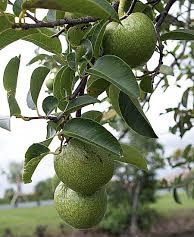
The fruits are very distinctive, being almost perfectly spherical (they’re actually berries). They are edible but need to be treated with caution – as the Latin name suggests, parts of the fruit (especially the seeds) are poisonous, containing strychnine.
The fruit are usually picked before they are ripe and kept in storage. The hard outer shell means they are easy to transport, and the ripe fruit last for a long time. The outside shell turns from green to yellow when its ripe. The inside of the fruit is a yellow, strong-smelling pulp.
The fruit can also be sun or oven dried. The dried pulp is then ground into a porridge which can be kept, unrefrigerated for up to 3 years.
The roots, bark, seeds, and unripe pulp are used for snake bites, and as an emetic and a laxative due to the presence of Strychnine. Fresh leaves are pounded into a paste and used as a natural insecticide, and to treat sores. The ripe fruit can be eaten raw or dried in the sun to make fruit rolls. The fruit can also be left to ferment in the sun and is used to make bitter tasting beer.
 Tourism Tails