Grasslands:
Grasslands occupy 25% of the earth’s surface. They are the home of the largest terrestrial mammal Elephant, the fastest runner Cheetah, the largest bird Ostrich and the heaviest snake Anaconda. The vegetation type in grassland is mainly dominated by grass and small plants. Dry climate prevails in grasslands throughout the year. The annual rainfall is less and comparable to forests. Lack of nutrients in soil implies poor vegetation.Grasslands are occupied by many grazing animals like zebra, gazelles, wildebeest, rhinoceros etc. Carnivores like lions, leopards and cheetahs are also an important part of the food chain in a grassland ecosystem.
Adaptations of animals in grasslands:
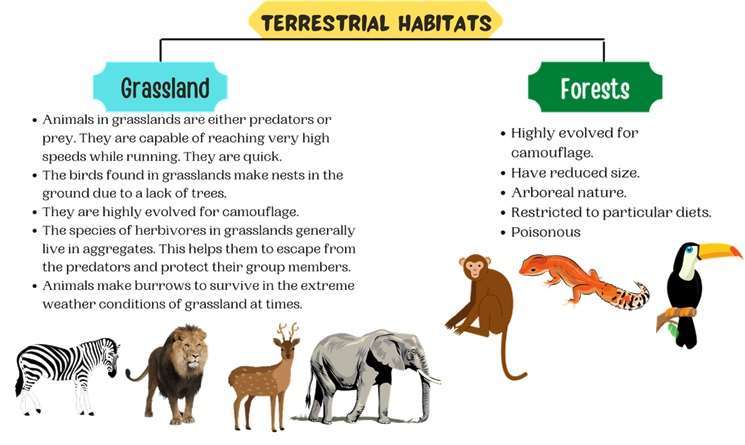
Animals in grasslands are either predators or prey. They are quick and are capable of reaching very high speeds while running. The birds found in grasslands make nests in the ground due to a lack of trees. The animals are highly evolved for camouflage. It helps them to hide in the open grounds. The herbivores in grasslands generally live in aggregates because it helps them escape the predators and protect their group members. Some animals make burrows to survive in the extreme weather conditions prevailing in the grasslands at certain times of the year.
Forests:
Forests are the home to almost 80 per cent of flora and fauna. Forests play a vital role in oxygen production. Along with plants and animals, they serve as the habitat for human beings, especially the tribal population. Along with plants and animals, they serve as the habitat for human beings, especially the tribal population.
Adaptations of animals in forests:
Camouflage – It is a type of adaptation that allows an animal to blend with its surroundings. Due to their skin colouration and skin texture, the animals appear in such a way that it becomes difficult to isolate them from their surroundings. So, the predator cannot spot such an animal in the forest.
Mimicry – Some animals are adapted to look like other objects and animals around them.
Limited diet – Some animals residing in the forest have adapted themselves to a limited diet in order to lower the competition for food.
Highly poisonous – Animals in the tropical rainforest are brightly coloured and highly poisonous, enabling them to survive in an environment surrounded by many predators.
Reduction in size and stature – Due to dense understorey, it will be difficult for large animals to move freely in dense forests. Hence, they have a reduced size compared to animals in other habitats.
Arboreal nature – To avoid the competition for food and space in the lower layers of the forest, some animal species have adapted the arboreal habitat. They spend most of their time clinging to trees.
 Tourism Tails