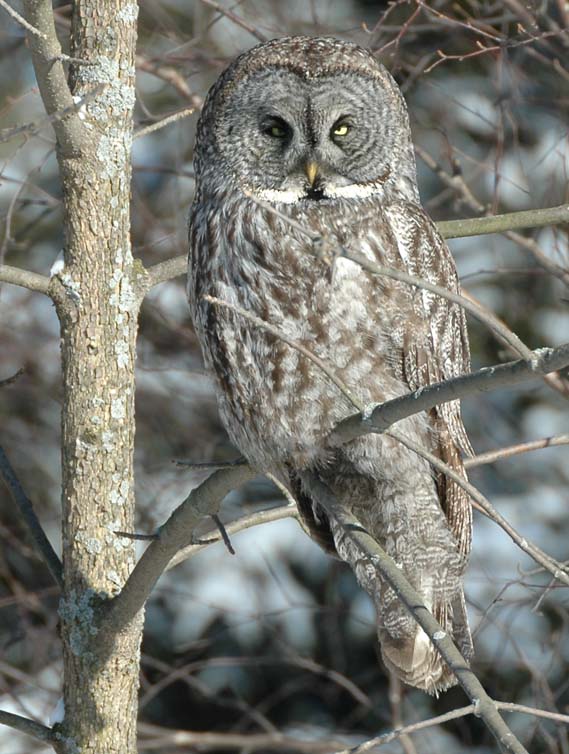
Owls have superb hearing, some of the best in the animal kingdom. The shape of their face makes for excellent hearing: have you ever noticed how flat their faces look? This is because owls have facial discs that are surrounded by a ring of feathers that help gather sound like a satellite dish collects signals. Each of those feathers is movable and can change position to better funnel sound. That sound is channelled through the feathers to their ear holes on the side of their head.
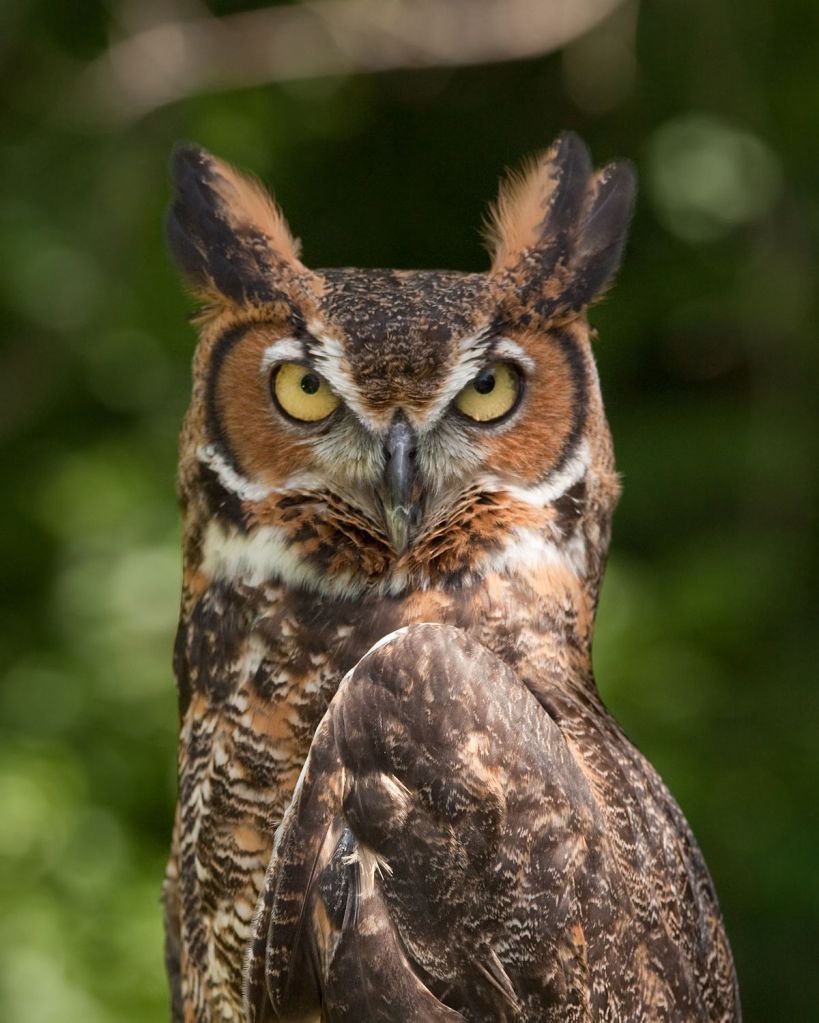
Wait, holes? But you heard their ears stick up! Those “ears” that stick up are actually feathers called plumicorns. They help with camouflage and communication with other owls but not with hearing. Their ears are actually on the sides of their head, just like yours! The ears are covered and protected by feathers and some owls even have flaps to protect the ears. This doesn’t hinder their hearing because the flaps are movable and can actually decrease the noise of turbulence during flight!
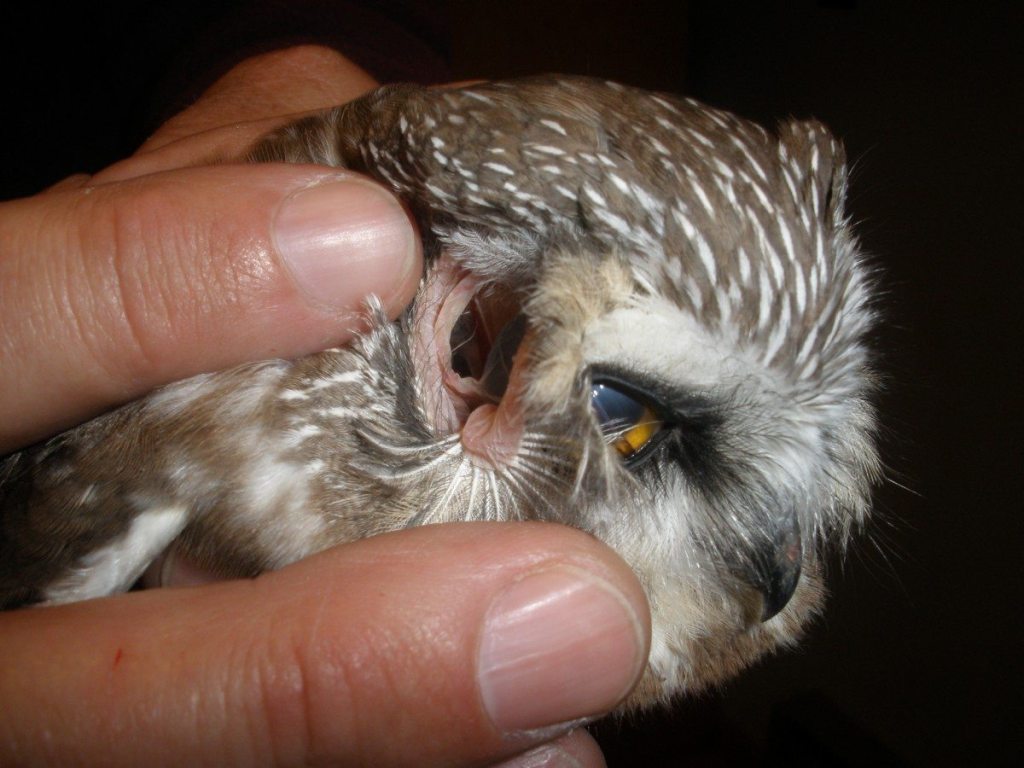
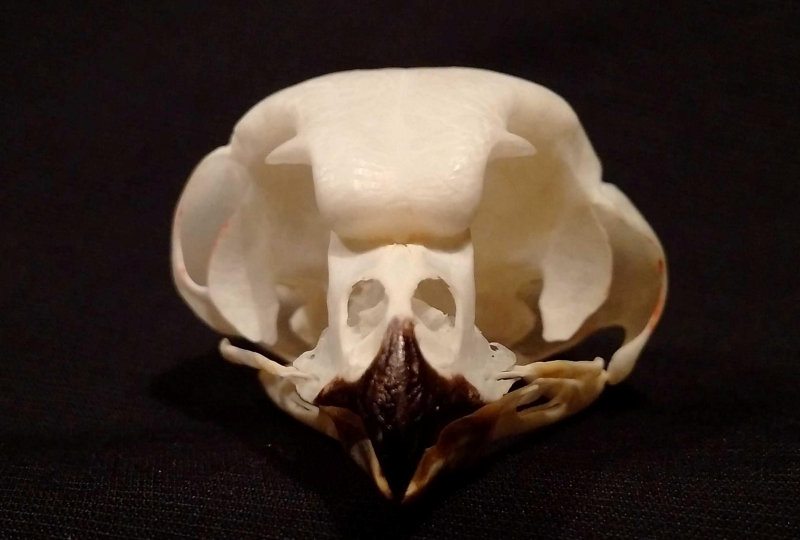
The ear holes themselves are super special too: they are asymmetrical. This means that one ear is higher than the other which is very helpful when it comes to hearing. With offset ears, the owl can tell not only if a sound is coming from the left or the right, but also from above or below. This setup is perfect for triangulating where a sound is coming from, sometimes to within millimetres of its origin. That triangulation allows an owl to swoop down, punch through a foot of snow, and pull out a mouse it has never seen! This asymmetry varies across owl species; some, like the Northern Saw-Whet skull pictured, have huge differences in the placement on the skull. Other species have their earflaps facing in different directions but the skull is less distorted-looking. Isn’t that amazing?!
Even cooler, many owls have a great ‘sound-location memory’ – this means that when they hear a sound, they make a map in their brain of where that sound is coming from relative to their location. They can do this because special cells in a distinct part of their brain are sensitive to sounds in different areas. This allows them to find the sound later. Try to think of it like this: if you have ever played marco polo or blind man’s bluff with friends, you’ll remember that when your eyes are closed you still usually have a good idea of where people are around you. This is because you can hear them and place them on your own ‘mental map.’
Finally, much like dogs, owls can hear a broader variety of sounds than we can and can also hear more details in the sounds. According to ProjectBeak, they can also “hear faster…humans can process sounds in bytes about 1/20 of a second long, but birds can distinguish notes up to 1/200 of a second. This means where we hear only one sound, a bird may hear as many as 10 separate notes!” Regardless of what you may hear about them, owls have some incredible hearing abilities. It makes you wonder what we humans are missing!
 Tourism Tails