Jellyfish are fascinating marine creatures that are often observed in large numbers along coastlines under specific environmental conditions. Among the factors influencing their appearance, wind patterns play a significant role. The relationship between jellyfish presence and wind conditions can be explained by the passive nature of jellyfish movement, the role of ocean currents, and the way wind influences water surface dynamics. Understanding these dynamics is crucial for predicting jellyfish blooms and managing their impact on coastal activities.
Jellyfish lack strong swimming abilities, relying instead on the currents and tides to carry them through the water. As a result, their distribution is heavily influenced by external forces such as wind. When winds blow consistently from a certain direction, they can create surface currents that push jellyfish toward the shore or into concentrated areas. For example, onshore winds—those blowing from the sea toward the land—can drive surface water, and with it, jellyfish, toward the coastline. This results in the sudden appearance of jellyfish swarms along beaches.
Conversely, offshore winds, which blow from land toward the sea, can have the opposite effect, pushing jellyfish away from the shore and into deeper waters. This dynamic explains why jellyfish might be more or less abundant in certain coastal areas depending on the prevailing wind conditions.
Another wind-related phenomenon that affects jellyfish distribution is Langmuir circulation. This is a process that occurs when steady winds create a series of parallel, rotating water cells on the ocean’s surface. These cells form alternating zones of convergence (where water comes together) and divergence (where water moves apart). Jellyfish, along with other floating objects and organisms, tend to accumulate in the convergence zones. This accumulation can lead to the formation of long lines or patches of jellyfish, which can be seen stretching along the water surface. As these zones of convergence are shaped and moved by the wind, large numbers of jellyfish can be transported toward the shore or concentrated in particular areas.
Wind patterns are also linked to seasonal changes, which can trigger jellyfish blooms—sudden increases in their population. In many regions, the onset of seasonal winds, such as the monsoons or trade winds, coincides with a rise in jellyfish numbers. These winds can enhance upwelling, a process where deep, nutrient-rich water rises to the surface, providing an ideal environment for the growth of plankton. Since jellyfish feed on plankton, an increase in plankton due to upwelling can lead to a corresponding increase in jellyfish populations. As the wind-driven currents move these blooming populations, they may become more noticeable along certain coastlines.


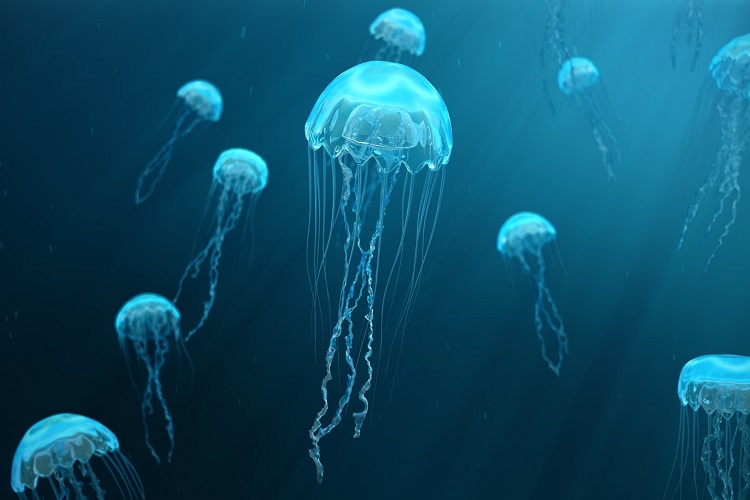
The appearance of jellyfish in certain wind conditions is closely linked to their passive movement and the way wind influences oceanic currents and surface dynamics. Onshore winds can push jellyfish toward the coast, while offshore winds may drive them away. Phenomena like Langmuir circulation further contribute to the accumulation and distribution of jellyfish in specific patterns. Additionally, seasonal wind patterns can indirectly promote jellyfish blooms by enhancing the conditions favourable for their prey. By understanding these relationships, scientists and coastal managers can better predict and respond to jellyfish occurrences, helping to mitigate their impact on tourism, fishing, and coastal ecosystems.
 Tourism Tails